
Sometimes the most memorable discoveries happen when we least expect them. Discovering a Traditional Coconut Scraper Hidden in an Old Garage turned what seemed like an ordinary day of cleaning into an unforgettable journey through family history, cultural traditions, and forgotten craftsmanship. What initially appeared to be a strange and mysterious object eventually revealed a fascinating story that connected generations and offered a glimpse into culinary practices from another part of the world.
Old garages often serve as time capsules. Over the years, they collect tools, furniture, keepsakes, and objects whose stories gradually fade from memory. While many items eventually become clutter, some hold hidden significance waiting to be rediscovered. That was exactly the case during a family effort to organize our grandfather's garage. What began as a routine cleaning project soon became a lesson in curiosity, heritage, and appreciation for traditional tools.
Several years after our grandfather passed away, we finally decided to tackle the overflowing garage he had filled throughout a lifetime of travels and adventures. We expected to find old tools, forgotten boxes, and perhaps a few sentimental keepsakes. Instead, hidden beneath a dusty tarp behind stacks of cardboard boxes, we uncovered a peculiar wooden object unlike anything we had seen before. Its unusual design sparked immediate curiosity, leading us down a path of discovery that taught us far more than we anticipated.
The Mysterious Object Hidden Beneath the Dust
An Unexpected Discovery
The object immediately caught our attention.
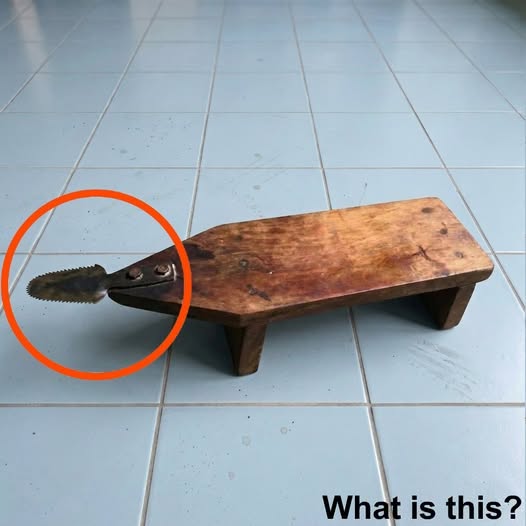
Unlike many of the surrounding items, it seemed carefully crafted and purposeful. Its construction featured a small wooden seat supported by short legs. Years of use had left visible signs of wear, including small cracks and a smooth patina that only develops through age.
Although weathered, the object remained remarkably sturdy.
It clearly had a specific purpose, yet none of us could identify it immediately.
The mystery deepened as we examined its unusual shape.
The Strange Serrated Blade
The most puzzling feature was attached to the front.
A curved metal piece lined with sharp, serrated teeth extended outward from the wooden frame.
At first glance, it resembled:
- A saw blade
- A woodworking tool
- A farming implement
- A machine component
However, none of those explanations seemed entirely convincing.
The positioning of the blade suggested it was designed for repetitive manual use. Yet exactly how it functioned remained unclear.
Naturally, speculation followed.
Searching for Answers
Family Memories Provide a Clue
As we debated possible explanations, our conversation shifted toward memories of our grandfather.
He had traveled extensively throughout his life, often collecting unique objects from different cultures. Many of the items he brought home reflected everyday traditions rather than expensive souvenirs.
This realization offered an important clue.
Perhaps the object was not unusual at all within its original cultural context.
Instead, it might simply be unfamiliar to us.
Researching Traditional Tools
Motivated by curiosity, we began researching traditional tools from various regions around the world.
Several design features stood out:
- The low wooden seat
- The forward-facing position
- The curved serrated blade
- The compact structure
Eventually, images of traditional coconut scrapers began appearing in our searches.
The resemblance was undeniable.
Suddenly, everything started to make sense.
Understanding the Traditional Coconut Scraper
How the Tool Works
A traditional coconut scraper is a practical kitchen tool commonly found in regions where coconuts play a major role in daily cooking.
Its design is both simple and efficient.
The user sits on the wooden seat while holding a halved coconut against the serrated metal blade.
By moving the coconut flesh against the sharp teeth, the soft interior is grated into fine pieces.
The resulting coconut can then be used in:
- Curries
- Desserts
- Breads
- Sauces
- Traditional beverages
Every element of the scraper serves a specific purpose.
What initially appeared strange was actually highly functional.
Why Coconut Scrapers Matter
In many tropical regions, fresh coconut remains an essential ingredient.
Before modern electric appliances became widely available, tools like coconut scrapers allowed families to process coconuts quickly and efficiently.
The scraper represents generations of practical innovation.
Its design evolved over time to meet the needs of daily life while requiring no electricity or complex mechanisms.
This simplicity is part of what makes traditional tools so remarkable.
More Than a Kitchen Tool
A Connection to Cultural Heritage
Once we identified the object, our perspective changed completely.
The scraper was no longer simply an old piece of equipment.
Instead, it became a symbol of cultural tradition and human ingenuity.
Traditional kitchen tools often reflect local ingredients, cooking methods, and ways of life. In this case, the coconut scraper offered insight into communities where fresh coconut remains a cornerstone of cuisine.
It represented not only a practical tool but also a connection to cultural heritage.
A Link to Family History
Perhaps even more meaningful was the connection to our grandfather.
The coconut scraper reminded us of his curiosity about the world.
He enjoyed collecting objects that reflected the daily lives of ordinary people. Rather than focusing solely on landmarks or tourist attractions, he appreciated the tools and traditions that shaped local communities.
Finding the scraper allowed us to reconnect with that aspect of his personality.
It became a tangible reminder of his adventures and his appreciation for diverse cultures.
Lessons Learned From the Discovery
The Value of Curiosity
Had we dismissed the object as junk, its story might have been lost forever.
Instead, curiosity encouraged us to ask questions and seek answers.
That simple decision transformed confusion into understanding.
The experience reinforced the idea that unfamiliar objects often become meaningful once we learn their history and purpose.
Knowledge changes perception.
Preserving Stories Hidden in Everyday Objects
Many older items contain stories that extend far beyond their physical appearance.
Objects preserved in attics, garages, and storage rooms often carry connections to:
- Family history
- Cultural traditions
- Technological innovation
- Personal memories
By taking the time to explore these items, we preserve more than possessions.
We preserve stories.
The coconut scraper taught us that even the simplest objects can offer valuable lessons when viewed through the lens of history and curiosity.
Frequently Asked Questions
What is a traditional coconut scraper?
A traditional coconut scraper is a manual kitchen tool used to grate fresh coconut flesh from inside the shell.
How does a coconut scraper work?
The user sits on the attached seat and presses a halved coconut against the serrated metal blade to scrape out the flesh.
Where are coconut scrapers commonly used?
They are widely used in regions where coconuts are a staple ingredient, including parts of Asia, Africa, and the Caribbean.
Why was the coconut scraper difficult to identify?
Its design differs significantly from many modern kitchen tools, making it unfamiliar to people who have never encountered one before.
Why are traditional tools important?
Traditional tools provide insight into cultural practices, historical lifestyles, and practical innovations developed over generations.
Conclusion
Discovering a Traditional Coconut Scraper Hidden in an Old Garage became much more than a simple identification exercise. It evolved into a meaningful exploration of culture, family history, and traditional craftsmanship. What first appeared to be an unusual object ultimately revealed a rich story about culinary traditions and the enduring value of curiosity.
The experience serves as a reminder that history often hides in unexpected places. Whether tucked away in a garage, attic, or forgotten storage box, ordinary objects can hold extraordinary stories. Sometimes all it takes is a closer look and a willingness to learn to uncover the remarkable meaning hidden within everyday items.


Leave a Reply