
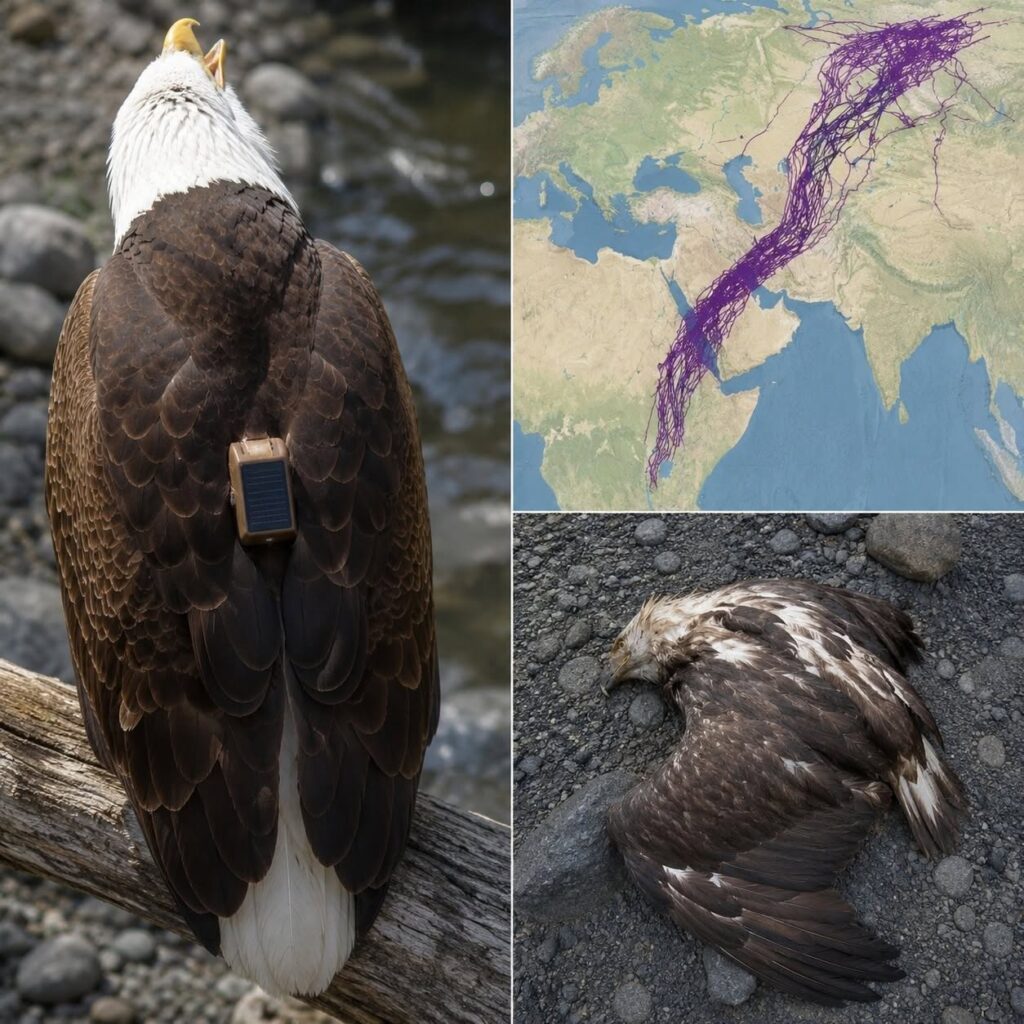
The Evolution of Wildlife Tracking
Early wildlife research depended on visual observation and metal leg bands.
While helpful, these methods provided only occasional information.
Modern GPS devices can transmit location data multiple times each day through satellites.
Some systems also record:
- Altitude
- Flight speed
- Temperature
- Time of movement
- Duration of flight
These technologies have revolutionized conservation science.
Migration Is Far More Complex Than It Appears
At first glance, eagle migrations may seem unpredictable.
Routes often include:
- Sudden turns
- Large loops
- Temporary stops
- Unexpected detours
However, when researchers compare flight paths with environmental conditions, clear patterns emerge.
Rather than flying in straight lines, eagles constantly adapt to changing conditions.
Reading Invisible Highways in the Sky
One of the greatest discoveries from long-term tracking involves how birds use atmospheric conditions.
Large soaring birds rely heavily on:
Thermal Updrafts
Warm air naturally rises from the Earth's surface.
Eagles circle within these invisible columns to gain altitude without flapping their wings.
Once high enough, they glide long distances before locating another thermal.
This strategy conserves enormous amounts of energy.
Mountain Winds
Mountain ranges create predictable wind patterns.
Experienced birds often use these air currents to travel efficiently across difficult terrain.
Coastal Airflows
Along coastlines, changing temperatures between land and water generate favorable wind conditions.
These invisible "air highways" help birds travel with minimal effort.
Energy Conservation Is Essential
Flying requires tremendous energy.
Every unnecessary wingbeat increases calorie consumption.
Long-term studies show that eagles carefully balance:
- Distance
- Weather
- Wind
- Food availability
- Rest opportunities
Instead of choosing the shortest route, they often select the most energy-efficient one.
This behavior improves survival over thousands of miles.
Remarkable Navigation Abilities
Scientists continue studying how birds navigate with such precision.
Current research suggests they may use several tools simultaneously.
Possible navigation systems include:
- The position of the sun
- Earth's magnetic field
- Visual landmarks
- Wind patterns
- Learned migration routes
- Instinct
Young birds gradually improve their navigation through experience.
Older birds often demonstrate remarkable consistency across multiple migration seasons.
Adapting to Changing Weather
Weather strongly influences eagle behavior.
GPS tracking shows birds frequently alter their routes to avoid:
- Severe storms
- Strong headwinds
- Heavy rain
- Extreme turbulence
Rather than forcing their way through dangerous conditions, they often pause temporarily before continuing.
This flexibility increases survival.
Eagles Are Skilled Decision-Makers
Far from behaving randomly, tracked eagles repeatedly demonstrate sophisticated decision-making.
Researchers have documented birds adjusting travel based on:
- Wind direction
- Food sources
- Predator presence
- Human activity
- Seasonal changes
These adjustments occur continuously throughout migration.
The Importance of Habitat
Tracking studies reveal that successful migration depends upon healthy habitats.
Important stopover locations provide:
- Food
- Fresh water
- Safe resting areas
- Shelter from severe weather
Protecting these habitats supports not only local wildlife but entire migration systems spanning multiple countries.
Conservation Benefits of Tracking
Satellite research has become one of conservation's most valuable tools.
Tracking data helps identify:
- Critical nesting sites
- Migration corridors
- Habitat loss
- Dangerous power lines
- Wind turbine placement concerns
- Areas requiring legal protection
Governments and conservation organizations use this information to improve wildlife management.
Threats Facing Eagles Today
Although many eagle populations have recovered thanks to conservation efforts, challenges remain.
Major threats include:
Habitat Loss
Urban development reduces available nesting and hunting areas.
Poisoning
Lead ammunition fragments and certain environmental toxins continue affecting wildlife.
Collisions
Power lines and vehicles sometimes cause fatal injuries.
Climate Change
Changing weather patterns may alter migration timing and food availability.
Human Disturbance
Repeated disturbance near nests can reduce breeding success.
Lessons About Nature
Perhaps the greatest lesson from long-term tracking is one of humility.
What once looked like random wandering often proves to be a highly sophisticated response to changing environmental conditions.
Nature rarely follows the simple patterns humans expect.
Instead, wildlife constantly adapts through countless small decisions shaped by millions of years of evolution.
Technology and the Future of Research
Modern tracking devices continue improving.
New systems may include:
- Solar-powered transmitters
- Longer battery life
- More frequent GPS recordings
- Improved satellite communication
- Artificial intelligence for movement analysis
These advances promise even greater understanding of wildlife behavior.
Why Long-Term Studies Matter
Scientific discoveries often require patience.
A few weeks of observation rarely reveal lifelong behavioral patterns.
Decades-long research allows scientists to understand:
- Population trends
- Environmental change
- Breeding success
- Migration consistency
- Survival rates
Long-term data frequently challenges earlier assumptions.
What Eagles Teach Us
Watching an eagle soar effortlessly across the sky can appear almost magical.
Yet behind every graceful movement lies countless biological adaptations:
- Powerful vision
- Efficient flight mechanics
- Exceptional navigation
- Environmental awareness
- Flexible decision-making
These abilities enable survival in constantly changing environments.
Final Thoughts
Long-term eagle tracking has transformed our understanding of one of nature's most iconic birds. What might appear to be unpredictable flight paths often reflect careful responses to weather, terrain, wind, and energy conservation. Modern GPS technology has revealed that eagles navigate using an extraordinary combination of instinct, experience, and environmental awareness.
Beyond satisfying scientific curiosity, these discoveries have practical value. They help researchers protect migration routes, identify important habitats, reduce human-wildlife conflicts, and guide conservation efforts that benefit future generations of birds.
Perhaps the most important lesson is that nature often operates with a complexity that isn't immediately visible. The more scientists study wildlife over long periods, the more they discover that behaviors once dismissed as random are often remarkable examples of adaptation, resilience, and intelligence.
Every new flight recorded by researchers adds another piece to the puzzle, reminding us that there is still much to learn about the natural world and the extraordinary creatures that share it with us.


Leave a Reply